
Implant Restoration Alongside a Veneer: Planning the “Magic Four”
- Apr 2
- 3 min read
Why One “Problem Tooth” Is Rarely Just One Tooth
Few cosmetic cases highlight the value of clinical judgment and patient communication like a well‑executed Magic Four. In this case, we walk through a common scenario with uncommon nuance: a patient who presents wanting to replace a single implant crown—and leaves with a dramatically improved smile built on thoughtful diagnosis, precise execution, and trust.
This patient arrived for a cosmetic consult before her wedding, unhappy with the appearance of an implant crown on #8. From her perspective, this was a straightforward fix. From the clinician’s perspective, the opportunity was much bigger.

Seeing the Smile the Way Patients Don’t
Patients evaluate their smile almost exclusively in the mirror—static, straight on, and fleeting. As clinicians, we see far more: lip dynamics, speech patterns, tissue symmetry, axial inclinations, and the way incisal edges interact with the lower lip.
In this case, comprehensive photography and video revealed several key issues:
Width discrepancies between the centrals and laterals
A disrupted smile curve with an exaggerated step between incisal edges
Axial inclination challenges
Imbalanced gingival heights, particularly around the implant restoration
Rather than telling the patient what needed to change, the consult focused on showing her—from multiple angles, in motion, and without pressure. Silence, listening, and visual education allowed the patient to arrive at the decision herself.
The goal was never to “sell dentistry,” but to share an expert opinion on what would create the best balance of form, function, and esthetics.
Balancing White and Pink Esthetics
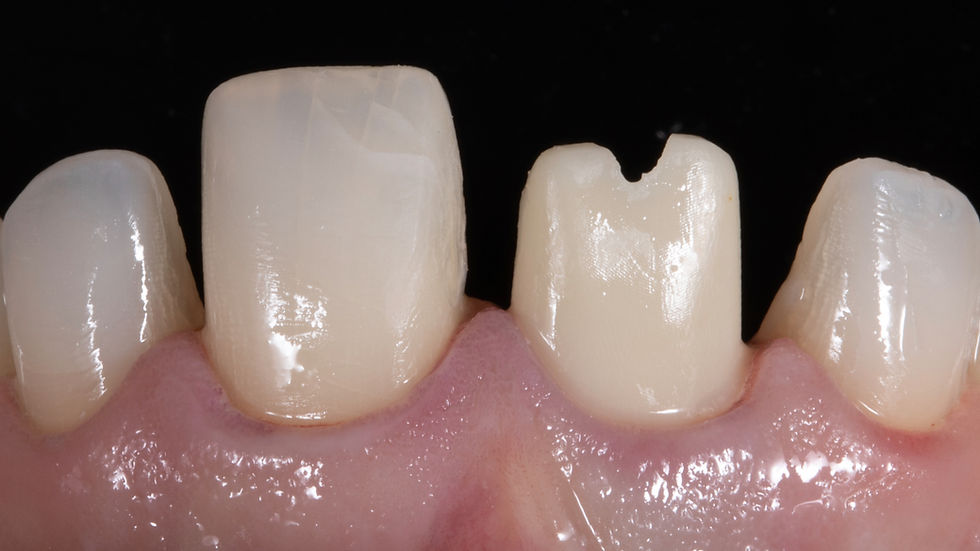
While the patient initially focused on the color and shape of the implant crown, tissue esthetics played an equally important role. The implant’s gingival margin sat noticeably higher than the adjacent teeth, raising questions about emergence profile convexity, implant position, and restorative contours.

Once the implant provisional was removed, it became clear that anatomy—not technique—was dictating the tissue position. The solution wasn’t to force the implant to comply, but to thoughtfully adapt the surrounding restorations:
Thinning the emergence profile where possible
Raising the gingival heights of the adjacent teeth to create symmetry
Tinting the implant abutment and provisional to better manage value and opacity
By managing expectations and working with the biology, the treatment plan achieved harmony rather than perfection.
Precision Records Make Confident Decisions
This case underscores the value of systematic records and strong lab communication. Full‑face photographs, retracted views, 12 o’clock perspectives, stick bites, facial references, and short functional video clips all played a role in helping the technician visualize how these restorations needed to live within the patient’s existing dentition.
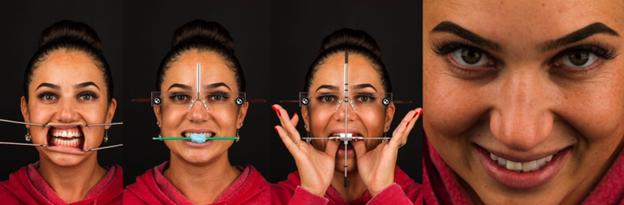
Provisionals were used not only to test esthetics, but to:
Refine tissue levels
Improve the smile curve
Adjust perceived tooth width using line angles
Evaluate shade blending relative to the canines and opposing arch
The result? No guesswork—and no “game‑day” decisions at delivery.
A Wedding‑Ready Outcome with Just Four Teeth
On the day of insertion, seating jigs ensured ideal abutment positioning, and a tinted implant abutment allowed the final restoration to blend seamlessly with the adjacent veneers. With only four teeth treated, the transformation was striking—balanced, natural, and confident.
The patient left with the smile she envisioned for her wedding day, and the clinician delivered a result built on skill, communication, and sound judgment.

Three Key Takeaways from This Case:
Patients see problems narrowly; clinicians must see them comprehensively. Education—not persuasion—guides better decisions.
Implants and veneers must be planned together. Emergence profiles, tissue heights, and shade management determine success.
Great records empower great outcomes. Photos, video, and thoughtful lab communication eliminate uncertainty and elevate results.
This is a powerful reminder that sometimes, changing everything only requires changing four teeth—when you approach the case with intention.
If you want to see the full workflow, watch the complete clinical video: Implant Restoration Alongside a Veneer
Members:
Not a member?
The Case Continuum gives you access to ongoing case discussions and focused clinical lessons that show how decisions are made—step by step.
Plan with clarity, execute with confidence, and deliver predictable results. I’m not only teaching techniques—I’m showing you exactly how to think through clinical challenges, month after month.


