Achieving Balance in a Smile with a Canted Maxilla
- Jan 28
- 2 min read
Cases involving a canted maxilla are always a challenge. The key is achieving symmetry without over-treating, because even subtle imbalances are noticeable.
In this case, a patient came to me seeking improvement for her asymmetric smile caused by a canted maxilla. The first step was evaluating her face and smile as a whole. Lines drawn from commissure to commissure and the position of her pupils revealed areas of imbalance, especially around the commissures. While her midline appeared centered, the cant became obvious when she smiled.

Examining her teeth in the context of her face, I focused on the canine positions, which are least affected by variables like lip length, age, or sex. Interestingly, her canines were already ideally positioned near the lip line, giving me a solid reference for designing the restorations.
From there, I evaluated both the pink and white esthetics. The gingival scallop and uneven tissue height required careful attention. Using a simple technique with floss to mark the gingival line, I could create a more symmetrical appearance without aggressive intervention. On the white side, I designed restorations for teeth 7, 8, 9, 10, and 11. Even though six restorations were originally planned, I reduced the number to five to preserve enamel and maintain minimally invasive principles.
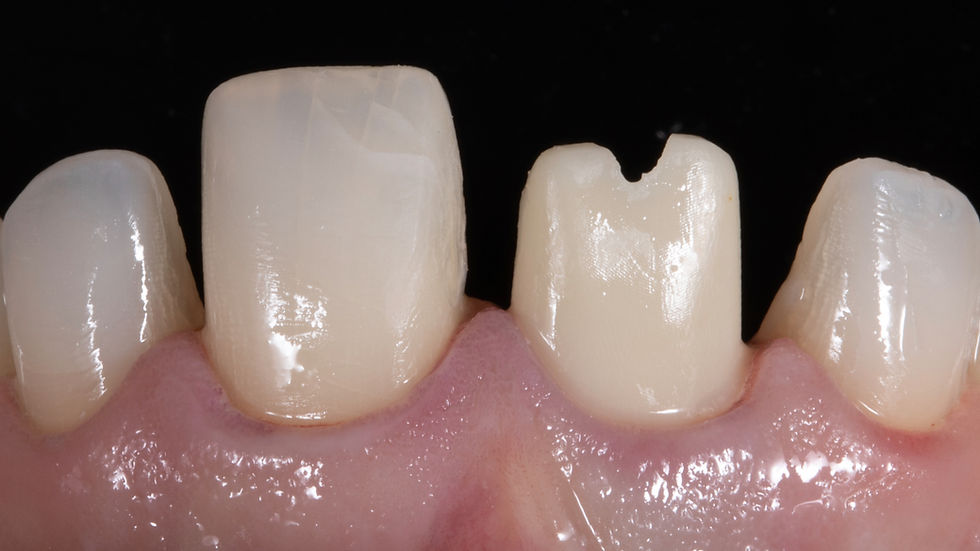
Preparation and isolation were critical for success. Minimal prep was performed on teeth 8 and 9, with complete isolation to ensure predictable bonding and optimal results. After crown lengthening and restoration insertion, the final outcome achieved improved symmetry, balance between the pink and white esthetics, and a natural, harmonious smile. While the cant itself was not fully corrected, the patient’s overall esthetic balance was greatly enhanced.

This case highlights how conservative, strategic planning can transform a challenging situation into a successful outcome.
Three Key Takeaways from This Case:
Assess the smile in the context of the face. Symmetry and balance are more noticeable than absolute alignment, so start with facial analysis.
Prioritize minimally invasive principles. Sometimes fewer restorations achieve better esthetic outcomes while preserving tooth structure.
Control both pink and white esthetics. Gingival positioning and tooth restorations must work together for a harmonious smile.
If you want to see the full step-by-step approach, including photos, scans, and the techniques I use to plan and execute these challenging cases, watch the complete clinical video, Perfecting Alignment with Pink and White Esthetics.

Members:
Not a member?
The Case Continuum gives you access to ongoing case discussions and focused clinical lessons that show how decisions are made—step by step.
Plan with clarity, execute with confidence, and deliver predictable results. I’m not only teaching techniques—I’m showing you exactly how to think through clinical challenges, month after month.