Designing Minimally Invasive Veneers: Why Orthodontic Setup, Smile Design and Tiny Details Matter
- Dec 11, 2025
- 2 min read
Updated: Dec 18, 2025
This minimally invasive veneer case is one I love sharing because it highlights something we don’t talk about enough: the small decisions that determine whether a conservative veneer case succeeds or becomes unnecessarily complicated. In the full clinical tip video, I walk through how I evaluated the esthetics, function and tooth position, and how those early decisions shaped every step of the treatment.

What looked like a straightforward veneer case revealed deeper challenges—axial inclinations that didn’t match, gingival levels that lacked balance, and a collapsed upper arch that limited my ability to stay truly additive. The goal was to create a fuller, more harmonious smile while preserving as much natural tooth structure as possible. To do that predictably, the orthodontic foundation mattered just as much as the veneer design.
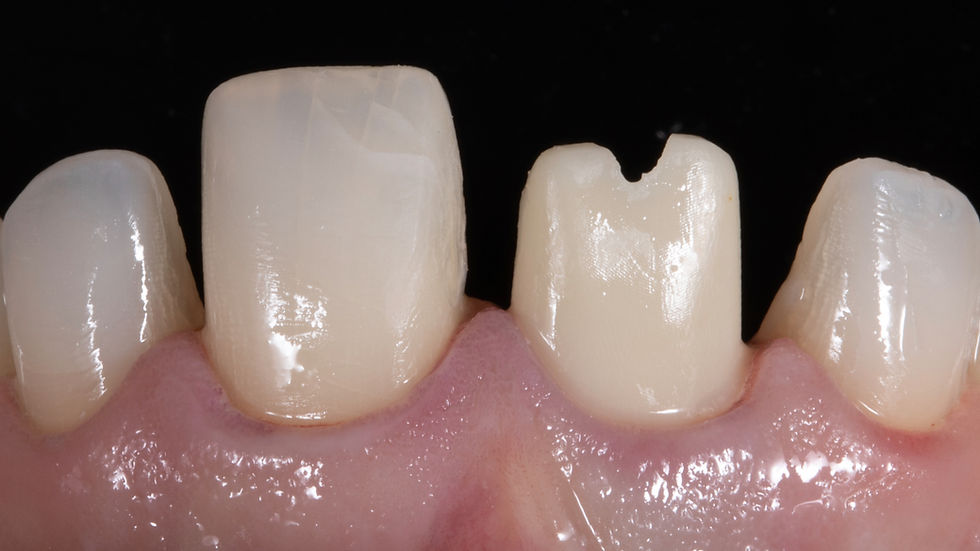
Clear aligner therapy helped correct the axial inclinations, open the bite, broaden the arch and give me a starting point where prepless veneers were actually feasible. From there, the smile design process revealed tiny areas—sometimes just 0.3 mm—where the natural tooth fell outside the ideal design. Those micro adjustments guided my preparations and reinforced how critical it is to plan with the end in mind.
This case is a perfect example of how smile design, lab communication and detailed preplanning let us deliver additive, ultrathin restorations without compromising esthetics or function. In the full video, I show the photos, scans, design overlays and the exact steps behind each decision so you can see how it all comes together.

If you want to see the full walkthrough, including all prep visuals, provisional steps, lab feedback and the final delivery, don’t miss the complete clinical tip.
Clinical Takeaways
Axial inclinations determine whether a case can remain minimally invasive. Clear aligners often need to precede veneers so you can avoid unnecessary reduction.
Plan the smile design before moving the teeth. Expansive orthodontic movements affect restorative space. Knowing the desired endpoint prevents overexpansion that forces you into aggressive prepping later.
Use a married model to identify subtle discrepancies. Even tiny areas—0.1 to 0.3 mm—outside the design matter when working with ultrathin feltspathic veneers.
Crown lengthening should focus on pair symmetry, not perfection. Matching centrals and laterals in pairs creates harmony even when ideal textbook proportions aren’t possible.
Photography and video are essential for lab communication and patient understanding. A 30 second lower lip dynamic video is often more revealing than a dozen photos.
This case shows how thoughtful planning lets us deliver natural, minimally invasive results even when the starting point is far from ideal. Watch the full video to see every step from aligner planning to final veneers.
This clincal tip is included in the Case Continuum.
Are you a member? Log in to your account.